
Bringing tobacco back from Spain after a stay or a border excursion raises a recurring question: how much can one transport without risking a customs penalty? Since the removal of the fixed ceiling in 2024, the answer is no longer as simple as a number of allowed cartons. The regulation now relies on a different mechanism, where the notion of personal consumption replaces the quantified quota.
Indicative threshold and legal limit on tobacco: two concepts that customs distinguishes
The most widespread confusion concerns the difference between an indicative threshold and a legal limit. For tobacco purchases between member countries of the European Union, there is no longer a binding legal ceiling since the 2024 reform. A traveler returning from mainland Spain to France is therefore not subject to a maximum number of cartons specified in the law.
What remains is a European indicative threshold set at 800 cigarettes, or 4 cartons. This benchmark serves as a trigger for customs agents: below this, the presumption of personal consumption works in favor of the traveler. Beyond this, the customs officer may request justifications.
To know precisely how many cartons of cigarettes to bring back from Spain in 2026, one must therefore think in terms of proof of personal use rather than a fixed quota.
| Criteria | Below 800 cigarettes | Above 800 cigarettes |
|---|---|---|
| Presumption | Presumed personal use | Possible suspicion of resale |
| Customs control | Generally smooth passage | Justification requested |
| Seizure | Unlikely unless resale indicators | Possible if commercial intent established |
| Fine | No (unless transporting for others) | Yes, if resale is established |

Criteria for evaluation by French customs at the Spanish border
The shift from 4 cartons to a system without a ceiling does not mean that anything goes. Customs agents have a set of criteria to assess whether the tobacco being transported is indeed for personal purchase.
- The quantity transported relative to the traveler’s profile: a non-smoker with ten cartons in the trunk attracts attention
- The frequency of border crossings, verifiable through control histories
- The packaging of the tobacco: cartons still in cellophane in large quantities, arranged like stock, suggest a commercial hypothesis
- The presence of cash or traces of multiple transactions on the same day
A regular and massive purchase is the main warning signal for customs, even if each crossing taken in isolation remains below the indicative threshold. Controls at the border posts of Perthus, La Jonquera, or Dantxaria primarily target recurring profiles.
What customs considers as resale
Resale is not limited to selling to a third party for payment. Regularly offering tobacco purchased in Spain to acquaintances, if the quantity is significant, can be reclassified. The burden of proof shifts to the traveler as soon as the threshold of 800 cigarettes is exceeded.
Canary Islands and mainland Spain: two distinct customs regimes
A common mistake is to apply the same rules to all of Spain. The Canary Islands are not part of the customs territory of the European Union. Travelers returning from there are subject to the rules applicable to non-EU countries, with much more restrictive allowances.
Specifically, a return from the Canary Islands to mainland France imposes the same limits as a return from Morocco or Turkey. The ceiling-free regime only applies to mainland Spain and the Balearic Islands.
This distinction also extends to French overseas departments and territories. A traveler bringing back tobacco from mainland Spain to Guadeloupe, for example, does not benefit from the intra-EU regime for the overseas part of the journey.
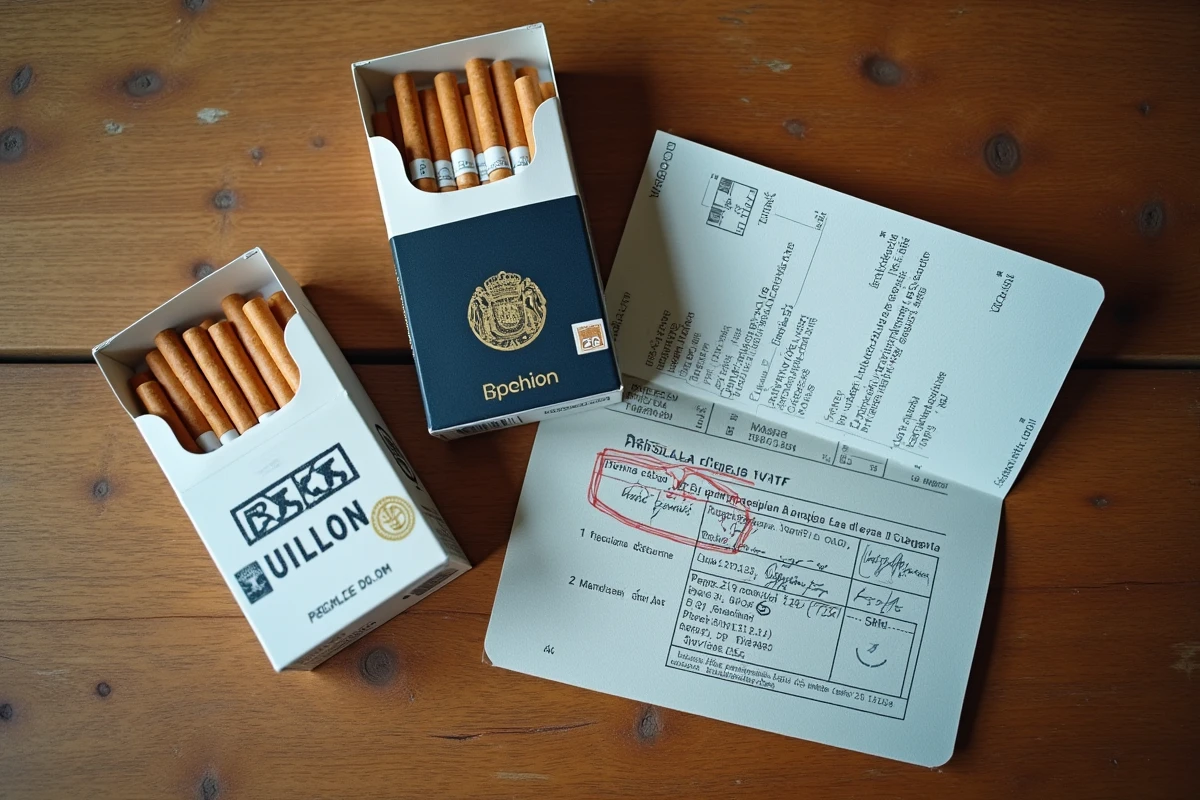
Customs penalties in case of established exceeding
When customs establishes that the transported tobacco is not intended for personal use, the consequences go beyond mere confiscation.
The seizure of tobacco is systematic as soon as commercial intent is established. The vehicle used for transport may also be seized conservatively if the quantities are very high.
Fines are calculated based on the value of the duties and taxes evaded. For tobacco, the amounts can rise quickly given the high taxation on cigarettes in France, among the highest in Europe. Criminal prosecution remains possible in cases of organized trafficking or documented recidivism.
The case of group purchases among friends
Buying for a friend who did not make the trip is a common practice, but legally risky. Each traveler can only justify their own consumption. Transporting cartons for a person absent from the vehicle during the control exposes one to reclassification as transport for others.
The regulation in 2026 is based on a simple principle: no fixed ceiling for trips from mainland Spain, but increased monitoring as soon as quantities exceed the indicative threshold of 800 cigarettes. The distinction between the Canary Islands and the mainland, often overlooked, remains the main trap for travelers who think they benefit from the same regime throughout Spain.